
Find Out If You Qualify for Dental Implants
Quick answer: A deep teeth cleaning (scaling and root planing) removes tartar and bacteria from below the gumline and smooths the roots so the gums can heal. It's the standard first treatment for periodontitis, gum disease that has spread below the gumline. At Grand Mission, it typically costs $200 to $400 per quadrant, or $800 to $1,600 for the full mouth.
You're in the chair for what you thought was a routine cleaning. The hygienist works around your mouth with a thin probe, calling out numbers: "Three, two, four, five, six."
Then the dentist comes in and says the words nobody wants to hear: "We'd recommend a deep cleaning."
Your first thought might be, Is this really necessary, or is it an upsell? Your second is probably, How much is this going to cost?
Both are fair questions.
The simple answer is that a deep cleaning reaches below the gumline, where a regular cleaning doesn't go, and it's the first-line treatment when gum disease has started to damage the tissue around your teeth.
The more honest answer is that it's only worth doing when your measurements and X-rays show it's needed, the cost depends on how much of your mouth is affected, and the results last only if you keep up with care afterward.
This guide walks through all three.
What Is a Deep Teeth Cleaning?
Your gums don't attach right at the top edge. There's a small groove between each tooth and the gum around it, called a pocket.
In healthy gums, that pocket is one to three millimeters deep. When plaque sits along the gumline long enough, the gums get inflamed, the pocket deepens, and bacteria move down onto the root, out of reach of your toothbrush and floss.
Plaque that stays put hardens into tartar (calculus), which bonds to the tooth and can't be brushed away.
A deep cleaning has two parts:
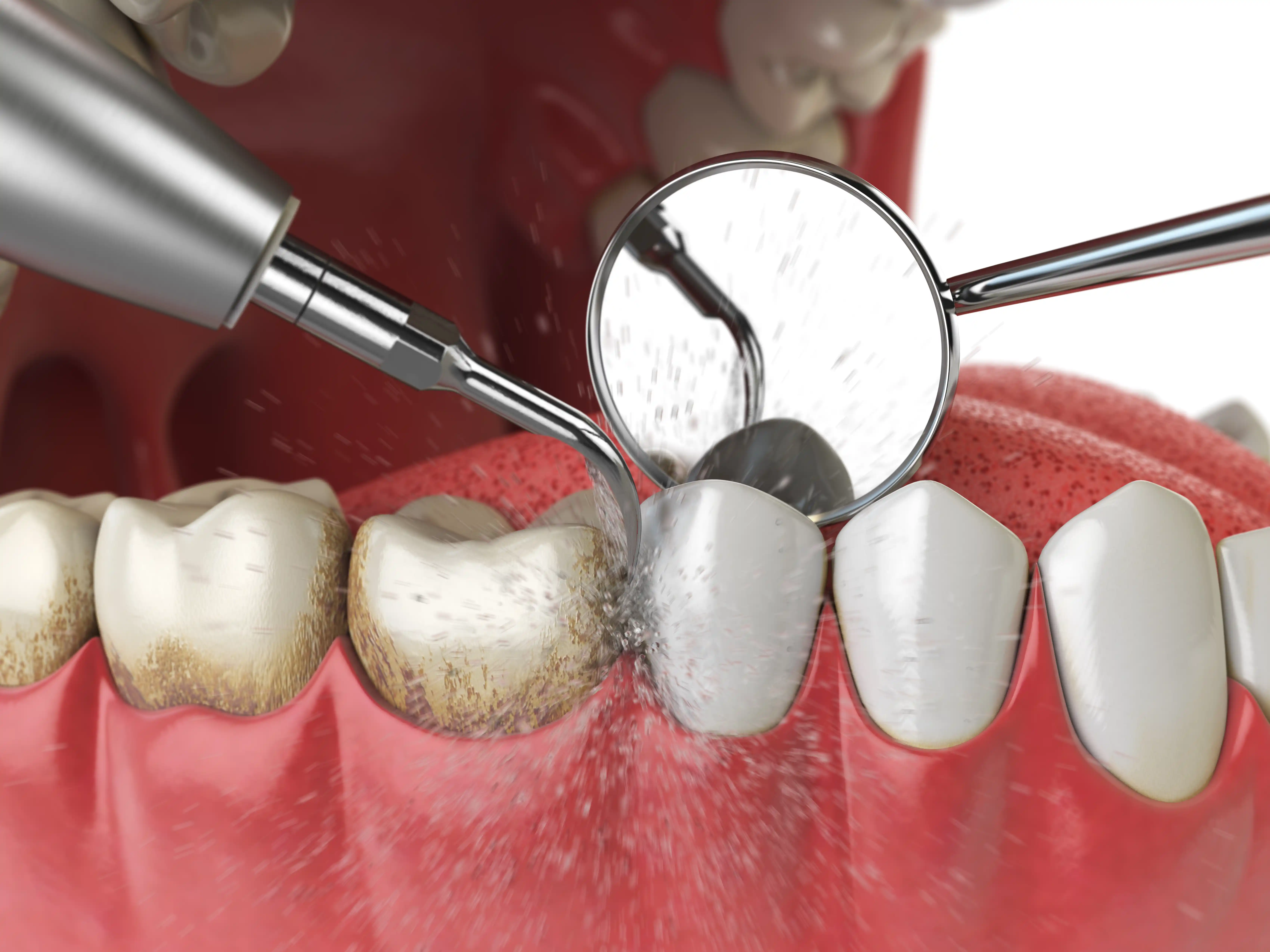
- Scaling removes plaque and tartar from the tooth and root surfaces below the gumline.
- Root planing smooths the root so there are fewer rough spots for bacteria to cling to and the gum can tighten back around the tooth.
This is more common than most people think. A national survey estimated that 42% of U.S. adults aged 30 and older have periodontitis, and 7.8% have the severe form (Eke et al., 2018).
A deep cleaning treats an infection below the gums. It isn't a more thorough polish.
How Do You Know If You Need a Deep Cleaning?
You usually can't tell on your own, because gum disease is rarely painful until it's advanced. Signs that point toward it include:
- Gums that bleed when you brush or floss
- Red, swollen or tender gums
- Bad breath or a bad taste that doesn't go away
- Gums pulling away from your teeth
- Teeth that feel loose or have shifted
Our post on the signs of gum disease covers these in more detail.
The decision itself comes from measurements, not symptoms. Pockets deeper than the healthy one to three millimeters, gums that bleed when they're probed, and bone loss on X-rays are what point toward a deep cleaning.
At Grand Mission, pocket depths are measured at every checkup, and X-rays are reviewed with the help of an FDA-validated AI diagnostic platform that supports the dentist's own review.
The Biggest Difference: Where the Cleaning Happens, Not How Hard It Is
A deep cleaning isn't just a more intense regular cleaning. The real difference is location.
A regular cleaning (prophylaxis) is preventive. It removes plaque and tartar above the gumline and just below it, in a mouth that's basically healthy.
A deep cleaning is treatment. It goes down into the pocket and cleans the root itself, which is why it usually needs numbing and more than one visit.
| Type of cleaning | Who it's for | What it involves | Grand Mission estimate |
|---|---|---|---|
| Regular cleaning (prophylaxis) | Healthy gums or early gingivitis | Cleaning above and just below the gumline, polish, floss and fluoride, usually in one visit | $100 to $300 with gingivitis treatment; often covered by insurance |
| Deep cleaning (scaling and root planing) | Early to moderate periodontitis with deeper pockets | Cleaning and smoothing root surfaces below the gumline under local anesthesia, usually over two to four visits | $200 to $400 per quadrant; $800 to $1,600 for the full mouth |
| Periodontal maintenance | Anyone who has been treated for periodontitis | Pocket checks and cleaning of treated areas every three to four months | $100 to $200 per visit |
If your gums are healthy, a professional cleaning every six months is what you need. A deep cleaning is for gums that have already started to pull away.
What Happens During a Deep Cleaning?
Here's how a deep cleaning usually goes as part of periodontal care at Grand Mission.
- Evaluation. Pocket depths are measured around every tooth, bone levels are checked on digital X-rays, and the gums are checked for bleeding. For moderate to advanced gum disease, an OralDNA saliva test can identify which bacteria are driving the infection.
- Numbing. Local anesthetic numbs the area being treated. Sedation is available if you'd like more help relaxing.
- Scaling. Ultrasonic instruments loosen tartar with gentle vibration, and hand instruments remove what's left from the root surfaces.
- Root planing. The roots are smoothed so the gum tissue can heal snugly against them.
- Quadrant by quadrant. Most patients need two to four appointments, with one or two quadrants treated per visit. Each appointment takes about 45 to 90 minutes.
- Re-evaluation. Four to six weeks later, pocket depths are measured again to see how the gums responded.
Does the type of instrument matter? Not much. A systematic review found no significant difference in results between hand and ultrasonic instruments (Suvan et al., 2020).
Is it better to do the whole mouth in one day? The same review found no meaningful difference between treating quadrant by quadrant and treating the full mouth at once. A Cochrane review reached a similar conclusion (Eberhard et al., 2015). So the schedule can be set around your comfort and your calendar.
Does a Deep Cleaning Hurt?
The treatment itself shouldn't hurt, because the area is numbed first. Most patients report minimal discomfort during the procedure.
Afterward, expect some tenderness for a few days that over-the-counter pain relievers usually handle.
Tooth sensitivity is the side effect most people notice. A review of the research found that 62.5% to 90% of patients reported root sensitivity the day after non-surgical periodontal treatment. That dropped to about 53% to 55% after a week, and it was generally mild to moderate and short-lived (Lin and Gillam, 2012).
If anxiety is what's holding you back, Grand Mission offers several levels of sedation dentistry, from nitrous oxide to IV sedation.
The numbing makes the procedure comfortable. Most of the discomfort comes in the few days afterward, and it fades.
What Are the Benefits of a Deep Cleaning?
Scaling and root planing has been the standard non-surgical treatment for periodontitis for decades, and newer treatments are still measured against it (Cobb, 2002).
Here's what the research shows it can do.
- Shallower pockets. Across clinical trials, pockets were about 1.4 mm shallower six to eight months after treatment, and an estimated 74% of pockets closed (Suvan et al., 2020).
- Firmer attachment. An American Dental Association expert panel found an average gain of about 0.5 mm in gum attachment after scaling and root planing (Smiley et al., 2015).
- Better blood sugar control for people with diabetes. In people with both diabetes and periodontitis, treatment lowered HbA1c by about 0.43 percentage points three to four months later (Simpson et al., 2022).
- Possible benefits for blood vessels. In one trial of people with severe periodontitis, blood vessel function had improved six months after intensive treatment (Tonetti et al., 2007).
- A healthier base for future dental work. Active gum disease has to be controlled before implants, crowns or other restorations are placed.
Our post on how gum disease can affect your overall health looks at those links in more detail.
What We Look at Before Recommending a Deep Cleaning
A deep cleaning should be a decision based on your numbers, not a default.
At our Richmond, TX office, which also cares for patients from Sugar Land, Katy, Fulshear and Rosenberg, the evaluation looks at:
- Pocket depths around every tooth. Where the deeper readings are decides whether you need treatment and how much of your mouth needs it.
- Bleeding when the gums are probed. This is a sign of active inflammation.
- Bone levels on X-rays. Bone loss separates gingivitis, which a regular cleaning can reverse, from periodontitis, which needs treatment below the gumline.
- Your health history. Diabetes and smoking are both linked to gum disease, and smoking dampens the response to treatment.
- Which bacteria are present. For moderate to advanced cases, OralDNA testing can help target the treatment.
- Your budget and coverage. Your benefits are checked before treatment, and the visits can be spaced out.
If you've been told elsewhere that you need a deep cleaning and aren't sure, Grand Mission offers a free second opinion.
What Are the Risks and Limits of a Deep Cleaning?
Scaling and root planing is well established, but it has limits.
- Short-term sensitivity and soreness are common, as covered above (Lin and Gillam, 2012).
- A brief inflammatory response. In the trial above, markers of inflammation were higher the day after intensive treatment, a short-term reaction, before blood vessel function improved by six months (Tonetti et al., 2007).
- Your gums may look different. As swelling goes down, some people notice their gums sit a little lower or the spaces between teeth look slightly larger.
- It doesn't rebuild lost gum or bone. It stops the infection. Recession that has already happened may need separate treatment such as gum tissue regeneration.
- Smoking weakens the response. Smokers saw smaller reductions in pocket depth after treatment than non-smokers (Chang et al., 2021).
- Add-ons offer modest extra benefit. Adjuncts such as locally placed antimicrobials added about 0.2 to 0.6 mm of extra attachment gain on average, depending on the product (Smiley et al., 2015). Whether one makes sense for you is a case-by-case decision.
- Some pockets don't close. Very deep pockets may still need further treatment after the re-evaluation.
How Much Does a Deep Teeth Cleaning Cost?
Deep cleanings are priced by quadrant, meaning one quarter of your mouth. These are Grand Mission's estimated ranges:
- Scaling and root planing, per quadrant: $200 to $400
- Full-mouth scaling and root planing (four quadrants): $800 to $1,600
- Periodontal maintenance visit: $100 to $200, every three to four months
- Regular cleaning with gingivitis treatment: $100 to $300
Your total depends on how many quadrants need treatment. Not everyone needs all four.
A few ways to manage the cost:
- Dental insurance. Grand Mission accepts most major PPO plans. Coverage for periodontal treatment varies from plan to plan, so the team checks your benefits before you start.
- HSA and FSA. These payments are accepted.
- Dental Savings Plan. If you don't have insurance, the Grand Mission Dental Savings Plan gives members 20% off periodontics. The single plan is $380 a year plus a one-time $50 enrollment fee, and it can't be combined with insurance.
- Financing.Cherry financing offers 0% APR options for qualified patients.
How Do You Keep Your Results After a Deep Cleaning?
Bacteria come back quickly when plaque is left in place. In one study, the bacteria under the gums returned within four to eight weeks in patients who weren't keeping plaque under control above the gumline (Magnusson et al., 1984).
That's why periodontal maintenance is scheduled every three to four months instead of every six. And it pays off: patients who kept up with regular maintenance had a 44% lower risk of losing teeth than those who came in irregularly (Lee et al., 2015).
European treatment guidelines also treat supportive care as a required step after active therapy, not an optional extra (Sanz et al., 2020).
At home:
- Brush twice a day along the gumline with a soft brush.
- Clean between your teeth every day with floss or interdental brushes.
- If you smoke, quitting gives your gums a better chance of healing.
- If you have diabetes, keep your doctor in the loop about your gum treatment.
The cleaning treats the disease. The maintenance visits and daily care keep it from coming back.
Frequently Asked Questions
Does the $189 New Patient Special include a deep cleaning?
No. The special covers a comprehensive exam, X-rays, a cleaning and a full treatment plan for new patients, but it isn't valid in cases of periodontal disease. If your exam shows you need a deep cleaning, the office will walk you through the cost before treatment.
Does the Grand Mission Dental Savings Plan cover periodontal maintenance?
Yes, up to a point. The plan's two included cleanings a year can be periodontal maintenance visits when there's no active infection. Because maintenance is usually recommended every three to four months, you may need one or two more visits a year beyond what the plan includes.
Can I drive myself home after a deep cleaning with sedation?
With nitrous oxide, you can usually drive yourself home once the gas has cleared. With oral sedation, IV sedation or deep sedation, you'll need someone to drive you and stay with you for a few hours.
When can I eat after a deep cleaning?
Wait until the numbness wears off so you don't bite your cheek or tongue. Softer foods are usually more comfortable for a day or two, and very hot or cold foods may feel sensitive. You'll get aftercare instructions at your visit.
Can I schedule deep cleaning visits outside work hours?
Often, yes. The office is open six days a week, with evening hours until 7 p.m. on Mondays and 8 p.m. on Tuesdays and Wednesdays, and Saturday hours from 8 a.m. to 3 p.m. Call to check which times are open for your appointment type.
Final Takeaways
- A deep cleaning treats gum disease below the gumline. A regular cleaning prevents it.
- The need for one should come from pocket measurements, bleeding and X-rays, not a guess.
- Sensitivity and soreness afterward are common and usually short-lived.
- Research shows shallower pockets, firmer attachment and better blood sugar control in people with diabetes.
- At Grand Mission, it typically costs $200 to $400 per quadrant or $800 to $1,600 for the full mouth.
- Maintenance every three to four months is what keeps the results.
Not sure whether you need a deep cleaning?Book a periodontal evaluation at Grand Mission Dentistry in Richmond, or call (281) 789-8836. You'll see your own pocket measurements and X-rays, and you'll know what treatment, if any, you need and what it will cost.
Research References
- Eke PI, Thornton-Evans GO, Wei L, Borgnakke WS, Dye BA, Genco RJ. Periodontitis in US adults: National Health and Nutrition Examination Survey 2009-2014. J Am Dent Assoc. 2018;149(7):576-588.e6. https://doi.org/10.1016/j.adaj.2018.04.023
- Suvan J, Leira Y, Moreno Sancho FM, Graziani F, Derks J, Tomasi C. Subgingival instrumentation for treatment of periodontitis. A systematic review. J Clin Periodontol. 2020;47 Suppl 22:155-175. https://doi.org/10.1111/jcpe.13245
- Eberhard J, Jepsen S, Jervøe-Storm PM, Needleman I, Worthington HV. Full-mouth treatment modalities (within 24 hours) for chronic periodontitis in adults. Cochrane Database Syst Rev. 2015;(4):CD004622. https://doi.org/10.1002/14651858.CD004622.pub3
- Lin YH, Gillam DG. The prevalence of root sensitivity following periodontal therapy: a systematic review. Int J Dent. 2012;2012:407023. https://doi.org/10.1155/2012/407023
- Cobb CM. Clinical significance of non-surgical periodontal therapy: an evidence-based perspective of scaling and root planing. J Clin Periodontol. 2002;29 Suppl 2:6-16. https://doi.org/10.1034/j.1600-051X.29.s2.4.x
- Smiley CJ, Tracy SL, Abt E, et al. Systematic review and meta-analysis on the nonsurgical treatment of chronic periodontitis by means of scaling and root planing with or without adjuncts. J Am Dent Assoc. 2015;146(7):508-524.e5. https://doi.org/10.1016/j.adaj.2015.01.028
- Simpson TC, Clarkson JE, Worthington HV, et al. Treatment of periodontitis for glycaemic control in people with diabetes mellitus. Cochrane Database Syst Rev. 2022;4(4):CD004714. https://doi.org/10.1002/14651858.CD004714.pub4
- Tonetti MS, D'Aiuto F, Nibali L, et al. Treatment of periodontitis and endothelial function. N Engl J Med. 2007;356(9):911-920. https://doi.org/10.1056/NEJMoa063186
- Chang J, Meng HW, Lalla E, Lee CT. The impact of smoking on non-surgical periodontal therapy: a systematic review and meta-analysis. J Clin Periodontol. 2021;48(1):60-75. https://doi.org/10.1111/jcpe.13384
- Magnusson I, Lindhe J, Yoneyama T, Liljenberg B. Recolonization of a subgingival microbiota following scaling in deep pockets. J Clin Periodontol. 1984;11(3):193-207. https://doi.org/10.1111/j.1600-051X.1984.tb01323.x
- Lee CT, Huang HY, Sun TC, Karimbux N. Impact of patient compliance on tooth loss during supportive periodontal therapy: a systematic review and meta-analysis. J Dent Res. 2015;94(6):777-786. https://doi.org/10.1177/0022034515578910
- Sanz M, Herrera D, Kebschull M, et al. Treatment of stage I-III periodontitis: the EFP S3 level clinical practice guideline. J Clin Periodontol. 2020;47 Suppl 22:4-60. https://doi.org/10.1111/jcpe.13290
Latest Post
- Monday 9 am–7 pm
- Tuesday 10 am–8 pm
- Wednesday 10 am–8 pm
- Thursday 8 am–6 pm
- Friday 8 am–6 pm
- Saturday 8 am–3 pm
- Sunday – Closed