
.webp)

General Dental Implant Questions
.webp)
Dental implants are artificial tooth roots — typically made of titanium — that are placed into the jawbone to replace missing teeth. They support crowns, bridges, or full-arch prosthetic teeth for a natural-looking, long-lasting smile.
Most adults with missing or damaged teeth, good overall health, and sufficient jawbone are candidates. Even if you've experienced bone loss, treatments like bone grafts or sinus lifts may help qualify you.
With proper care, dental implants can last decades and often a lifetime. The prosthetic teeth attached to the implants may need to be replaced over time due to natural wear.
Implants are permanent and securely fixed in the jawbone. Unlike dentures, they stay in your mouth and do not need to be removed.
Treatment Options & Procedures
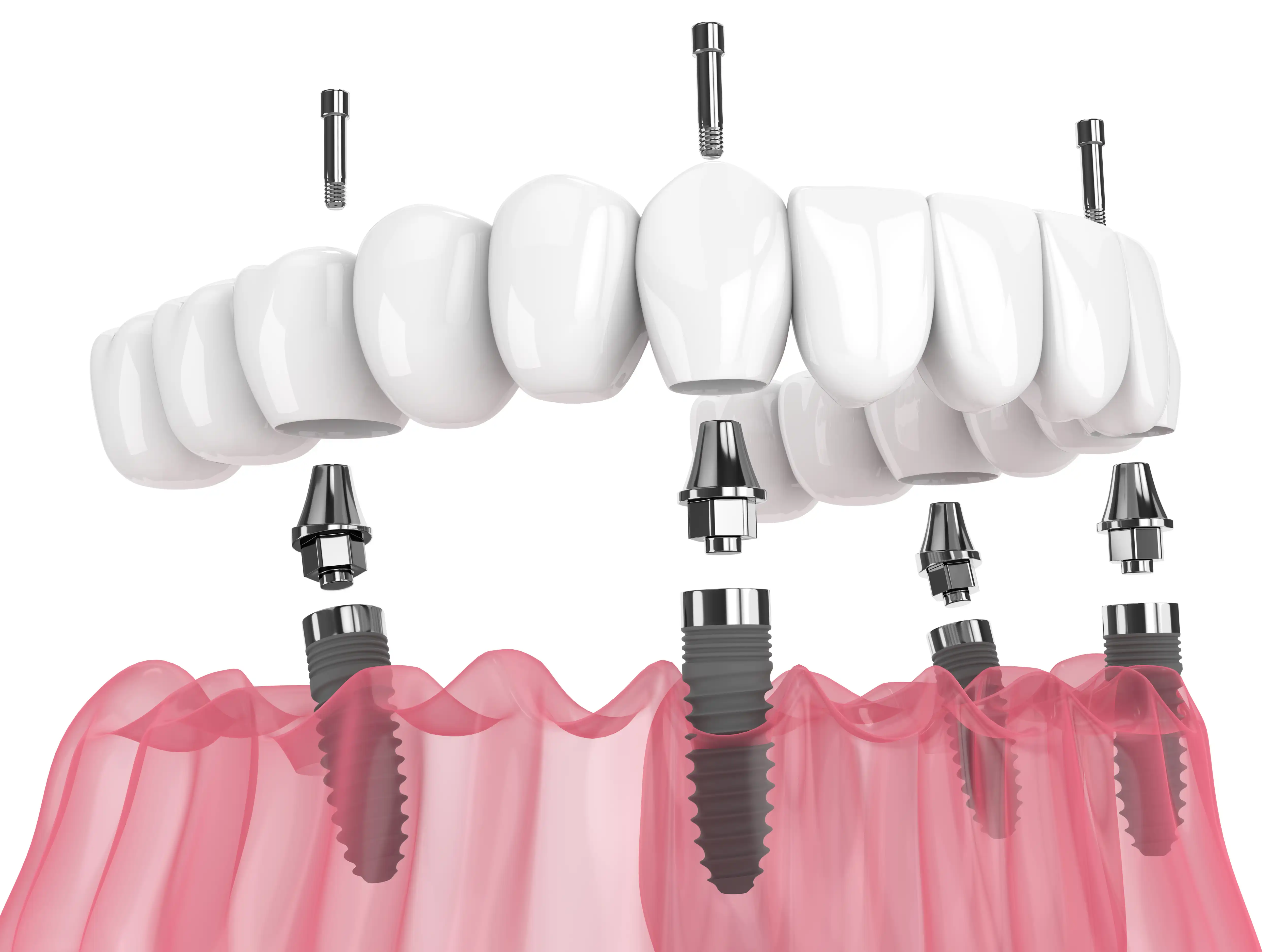
A Full Arch treatment uses 4 to 6 implants per arch to support a fully fixed set of new teeth. Treatment includes an exam, X-rays, all necessary extractions, sedation, and a fixed provisional restoration.
An overdenture is a removable, snap-in denture secured by 2 to 4 implants per arch using Locator attachments. It offers greater stability and retention than traditional dentures.
All-on-4® is a full-arch technique where four precisely placed implants support a complete set of fixed teeth. It provides same-day functionality for many patients and is similar to the Full Arch solution offered by Grand Mission Dentistry.
Traditional dentures cannot be turned into implants. However, existing dentures may sometimes be adapted to snap onto new implants, depending on their condition.
Implant Consultation & Process

A treatment coordinator takes a 3D cone beam CT scan of the mouth and jaw. Dr. Sung reviews the scan, assesses needs, and creates a personalized treatment plan. Patients also receive transparent pricing and financing options.
Most patients receive extractions, implants, and temporary fixed teeth in a single day. Healing takes several months before the final prosthesis is placed.
Sedation is included to ensure patient comfort. Most patients report minimal discomfort afterward, typically manageable with standard pain medication.
Patients may be asked to fast before sedation and arrange a ride home. The treatment coordinator provides detailed instructions before the procedure.
Care, Maintenance & Additional Information

Care for implants just as for natural teeth: brush, floss, and attend regular dental checkups. Overdentures should be removed and cleaned daily, while fixed teeth are maintained normally.
Dental implants have a success rate of over 95%, especially when placed by experienced professionals and when patients maintain good oral hygiene.
Zirconia (ceramic) implants are a metal-free alternative and may be an option depending on the case. Discuss this with Dr. Sung during the consultation.
Yes. Implants can significantly improve stability, chewing power, and confidence. Both implant-supported overdentures and fixed full-arch solutions are upgrades for denture wearers.
Your confident smile
Is our guide
Schedule your appointment today
Missing teeth don't have to mean compromise. Dental implants restore full chewing power, confidence, and a natural-looking smile that can last a lifetime — with Full Arch and Overdenture options starting at $2,999. Dr. Sung is ready to review your 3D scan and build a personalized treatment plan during your consultation.