
Find Out If You Qualify for Dental Implants
All posts
Tooth Extraction
Tooth Extraction Bleeding After 2 Hours: What's Normal and When to Worry

Published on:
June 05, 2026
Introduction
The moment after a tooth extraction, you expect the worst to be over, until you notice the bleeding that doesn’t seem to quit. A little oozing for the first few hours is normal (UW Medicine, 2019), but when that steady trickle keeps going, it can feel alarming.
This guide covers what’s normal at the 2-hour mark, four steps to slow the bleeding at home, what can restart it, and when to call us. The instructions below are drawn from university oral surgery clinics and published research, listed in the references at the end. If you’re still planning your extraction, see how we handle tooth extractions and wisdom tooth removal at our Richmond office.
Is Bleeding 2 Hours After a Tooth Extraction Normal?
Usually, yes. University of Washington oral surgeons tell patients to expect some minor bleeding for at least 2 to 4 hours after an extraction (UW Medicine, 2019). Oozing and blood-tinged saliva for up to about 8 hours is still described as normal bleeding (Kumbargere Nagraj et al., 2018).
What isn’t normal is bleeding that keeps soaking through fresh gauze. Call your dentist if bleeding lasts longer than 6 hours or seems heavy (UW Medicine, 2019).
Why the Socket Bleeds, and Why the Clot Matters
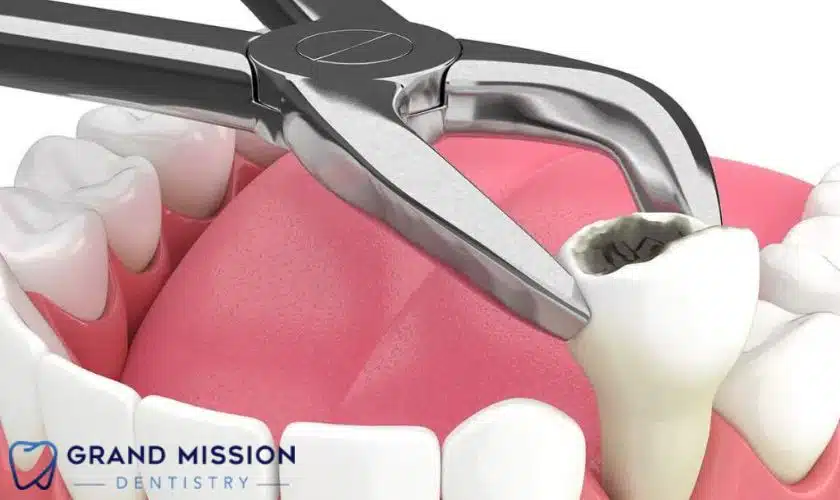
Removing a tooth leaves an open socket in the gum and bone, and a blood clot forms in it. If that clot breaks down or is lost, the bone underneath can be left exposed, which is a painful complication called dry socket (Kuśnierek et al., 2022).
That is why most aftercare advice is about leaving the clot alone: no rinsing or spitting for the first 24 hours, and nothing that creates suction, such as a straw (UW Medicine, 2019). If you’re not sure what kind of extraction you had, our guide to the different types of tooth extractions explains simple and surgical removal.
How to Stop the Bleeding in 4 Steps
There are no randomized trials comparing home treatments for prolonged bleeding after an extraction (Kumbargere Nagraj et al., 2018), so these steps follow the written instructions of university oral surgery clinics.
- Bite on gauze with steady pressure. Dampen clean gauze so it is moist but not wet, fold it twice into a thick pad, place it over the socket and bite down firmly (Eastman Institute for Oral Health, n.d.). Keep it in place for 30 to 60 minutes. If the socket is still bleeding, put in fresh gauze and hold it for another 30 to 60 minutes (Eastman Institute for Oral Health, n.d.; UW Medicine, 2019).
- Try a tea bag if it keeps oozing. If bleeding starts again, the University of Rochester’s oral surgery clinic suggests gently biting on a dry tea bag placed over the socket for 30 minutes (Eastman Institute for Oral Health, n.d.). In a randomized trial of 62 patients, gauze soaked in green tea extract stopped socket bleeding faster than plain gauze, and fewer patients were still oozing an hour later (Soltani et al., 2014). That study used tea extract, not a household tea bag, so treat a tea bag as a back-up to gauze, not a replacement.
- Keep your head up. Rest with your head raised on two or three pillows for the first 24 hours, including the first night (Eastman Institute for Oral Health, n.d.; UW Medicine, 2019).
- Rest, and leave the socket alone. Take it easy for at least the first 24 hours and avoid vigorous activity (UW Medicine, 2019); Rochester’s clinic advises avoiding excessive exertion for 72 hours (Eastman Institute for Oral Health, n.d.). Don’t rinse or spit during the first 24 hours (UW Medicine, 2019).
What Can Restart the Bleeding in the First Few Days
- Straws and sucking: don’t suck on a straw or hard candy for the first 24 hours, and skip straws for the first week (UW Medicine, 2019; Eastman Institute for Oral Health, n.d.).
- Spitting: avoid spitting for the first week (UW Medicine, 2019).
- Smoking: instructions range from no smoking for 24 hours (UW Medicine, 2019) to no smoking for 7 days (Eastman Institute for Oral Health, n.d.). Smoking is also linked to higher rates of dry socket (Kuśnierek et al., 2022), so the longer you can hold off, the better.
- Fizzy drinks and alcohol: avoid carbonated drinks and alcohol for at least the first 24 hours (UW Medicine, 2019).
- Hard, crispy food: avoid chips, hard pretzels and popcorn for the first week (Eastman Institute for Oral Health, n.d.).
What to Eat and Drink After an Extraction
Start with soft foods such as instant breakfast drinks, milkshakes (eaten with a spoon, not a straw), warm soups, yogurt and mashed potatoes (UW Medicine, 2019). Move back to firmer food as your mouth allows, and keep hard, crispy snacks off the menu for the first week (Eastman Institute for Oral Health, n.d.).
If you have diabetes, ask your dentist and your doctor how to plan meals around the extraction. For help with soreness, see our 5 tips for reducing pain and discomfort after a tooth extraction.
Why Some People Keep Bleeding
Bleeding that goes on longer than normal is often controlled with local measures such as pressure packs or a haemostatic (clot-promoting) material. Bleeding that local measures can’t control is usually linked to an underlying bleeding or clotting disorder (Kumbargere Nagraj et al., 2018).
Blood Thinners
In a meta-analysis of three studies of extraction patients, people taking two antiplatelet drugs together (dual antiplatelet therapy) had more bleeding after extraction than people taking none, while aspirin on its own was not significantly linked to extra bleeding. All the bleeding events in that analysis were minor (Zabojszcz et al., 2019).
Don’t stop a blood thinner on your own. A 2023 network meta-analysis notes that extractions can be done safely without changing antithrombotic medication when bleeding is controlled locally, and that stopping it is not justified (Mahardawi et al., 2023). Tell us about every medication you take before your extraction so we can plan for it.
High Blood Pressure
The evidence is mixed. A small 2025 study of 74 patients found that higher blood pressure went with longer bleeding after extraction (Pranoto et al., 2025), while a review of 4,260 emergency visits for post-extraction bleeding found no link between high blood pressure and how much people bled (Shao et al., 2024). If you have high blood pressure, let us know before the procedure.
Losing the Clot (Dry Socket)
Dry socket usually shows up as severe pain at the extraction site a few days after the procedure, sometimes with a bad taste or bad breath, after the clot has broken down (Kuśnierek et al., 2022). Its main symptom is pain rather than bleeding, and smoking is linked to a higher risk (Kuśnierek et al., 2022). If you plan to replace the tooth with an implant later, ask us whether socket preservation makes sense at the time of the extraction.
When to Call Your Dentist
- Bleeding lasts longer than 6 hours, or seems heavy (UW Medicine, 2019).
- Bleeding won’t stop after you’ve repeated the gauze steps (Eastman Institute for Oral Health, n.d.).
- Pain gets worse or lasts longer than 3 days, or swelling gets worse or hasn’t started to go down after 3 to 4 days (UW Medicine, 2019).
If you feel faint or dizzy, or the bleeding is heavy and you can’t reach your dentist, go to the nearest emergency room.

At the office, a dentist can re-pack the socket, place stitches or add an absorbable dressing. These were the main treatments used for post-extraction bleeding at one large dental hospital’s emergency department (Shao et al., 2024). For patients on blood thinners, tranexamic acid was the only local agent that significantly reduced bleeding events compared with standard gauze pressure and stitches in one network meta-analysis (Mahardawi et al., 2023).
If You Had Sedation
If you were sedated, a responsible adult must drive you home and stay with you, and you shouldn’t drive while you recover or while taking narcotic pain medication (Eastman Institute for Oral Health, n.d.). Read more about sedation dentistry at Grand Mission.
Keeping the Socket Clean
Don’t rinse or brush around the socket for the first 24 hours (UW Medicine, 2019; Eastman Institute for Oral Health, n.d.). From the next day, rinse gently with warm salt water (½ teaspoon of salt in 8 ounces of warm water) after meals and before bed (UW Medicine, 2019; Eastman Institute for Oral Health, n.d.).
Even after the bleeding stops, keep following your aftercare instructions until your dentist tells you otherwise. We’ll check the site at your follow-up visit.
Bleeding Won’t Slow Down? We’re in Richmond

Call Grand Mission Dentistry at (281) 789-8836. We hold same-day emergency appointments for patients in pain, and we can check the extraction site, place a new dressing or re-suture it if needed. You can also meet Dr. William Sung or read what to know before a tooth extraction.
Key Takeaways
- Light bleeding for the first few hours is expected. Call if it lasts longer than 6 hours or seems heavy (UW Medicine, 2019).
- Firm gauze pressure for 30 to 60 minutes is the first step; a tea bag is a back-up (Eastman Institute for Oral Health, n.d.; UW Medicine, 2019).
- Protect the clot: no rinsing or spitting for 24 hours, no straws for a week, and no smoking for as long as you can manage (UW Medicine, 2019; Eastman Institute for Oral Health, n.d.).
- Don’t stop blood thinners on your own. Tell your dentist about them before the extraction (Mahardawi et al., 2023).
FAQs
- How long should I expect bleeding to last after a tooth extraction?
Minor bleeding for at least 2 to 4 hours is expected, and oozing or pink-tinged saliva can continue for up to about 8 hours (UW Medicine, 2019; Kumbargere Nagraj et al., 2018). Call your dentist if bleeding lasts longer than 6 hours or seems heavy (UW Medicine, 2019). - What should I do if the bleeding starts again?
Fold fresh gauze into a thick pad, dampen it so it is moist but not wet, and bite down firmly over the socket for 30 to 60 minutes. If it keeps oozing, gently bite on a tea bag for 30 minutes. Don't rinse or spit (Eastman Institute for Oral Health, n.d.; UW Medicine, 2019). - Can medication cause prolonged bleeding?
Some can. People taking two antiplatelet drugs together had more minor bleeding after extractions than people taking none, while aspirin alone was not linked to extra bleeding (Zabojszcz et al., 2019). Don't stop a blood thinner on your own; tell your dentist and doctor about every medication you take (Mahardawi et al., 2023). - How should I sleep after a tooth extraction?
Keep your head raised on two or three pillows for the first night (UW Medicine, 2019; Eastman Institute for Oral Health, n.d.). If the bleeding picks up, sit up and bite on fresh gauze. - When should I contact Grand Mission Dentistry?
Call (281) 789-8836 if bleeding lasts longer than 6 hours or seems heavy, or if pain or swelling gets worse after the first few days (UW Medicine, 2019). You can also call any time you're unsure whether what you're seeing is normal. - What foods should I avoid after a tooth extraction?
Skip hard, crispy foods such as chips, hard pretzels and popcorn for the first week (Eastman Institute for Oral Health, n.d.), and avoid carbonated drinks and alcohol for at least the first 24 hours (UW Medicine, 2019). Start with soft foods such as yogurt, mashed potatoes, warm soup and milkshakes eaten with a spoon (UW Medicine, 2019).
Disclaimer: This blog provides general guidance and does not replace personalized dental care. Always follow the instructions your own dentist gives you, and seek professional evaluation for any post-extraction bleeding that persists or worsens.
References
- Eastman Institute for Oral Health, University of Rochester Medical Center. Oral surgery: surgical instructions [patient instructions]. n.d. Accessed November 19, 2026. https://www.urmc.rochester.edu/dentistry/patients/services/oms/surgical-instructions
- Kumbargere Nagraj S, Prashanti E, Aggarwal H, Lingappa A, Muthu MS, Kiran Kumar Krishanappa S, Hassan H. Interventions for treating post-extraction bleeding. Cochrane Database of Systematic Reviews. 2018;(3):CD011930. https://doi.org/10.1002/14651858.CD011930.pub3
- Kuśnierek W, Brzezińska K, Nijakowski K, Surdacka A. Smoking as a risk factor for dry socket: a systematic review. Dentistry Journal. 2022;10(7):121. https://doi.org/10.3390/dj10070121
- Mahardawi B, Jiaranuchart S, Arunjaroensuk S, Tompkins KA, Somboonsavatdee A, Pimkhaokham A. The effect of different hemostatic agents following dental extraction in patients under oral antithrombotic therapy: a network meta-analysis. Scientific Reports. 2023;13:12519. https://doi.org/10.1038/s41598-023-39023-7
- Pranoto AE, Runting N, Hermanto E. Post-extraction hemorrhage: assessing hypertension as a risk factor in dental extractions. Indonesian Journal of Dentistry. 2025;5(2):117–126. https://doi.org/10.26714/ijd.v5i2.17889
- Shao X, Xu XM, Yang X, Ji AP. Analysis of risk factors for post-extraction bleeding and study on emergency intervention strategies. Risk Management and Healthcare Policy. 2024;17:1279–1286. https://doi.org/10.2147/RMHP.S458260
- Soltani R, Haghighat A, Fanaei M, Asghari G. Evaluation of the effect of green tea extract on the prevention of gingival bleeding after posterior mandibular teeth extraction: a randomized controlled trial. Evidence-Based Complementary and Alternative Medicine. 2014;2014:857651. https://doi.org/10.1155/2014/857651
- UW Medicine, Oral and Maxillofacial Surgery Clinic, Harborview Medical Center. After a tooth extraction: caring for your mouth at home [patient education handout]. Published 2018; clinician review May 2019. https://healthonline.washington.edu/sites/default/files/record_pdfs/After-Tooth-Extraction.pdf
- Zabojszcz M, Malinowski KP, Janion-Sadowska A, Lillis T, Ziakas A, Sławska A, Janion M, Siudak Z. Safety of dental extractions in patients on dual antiplatelet therapy: a meta-analysis. Postępy w Kardiologii Interwencyjnej (Advances in Interventional Cardiology). 2019;15(1):68–73. https://doi.org/10.5114/aic.2019.83773
Latest Post
- Monday 9 am–7 pm
- Tuesday 10 am–8 pm
- Wednesday 10 am–8 pm
- Thursday 8 am–6 pm
- Friday 8 am–6 pm
- Saturday 8 am–3 pm
- Sunday: Closed